AI Actors and Digital Testimonials
Tipologia: AI Actors and Digital Testimonials
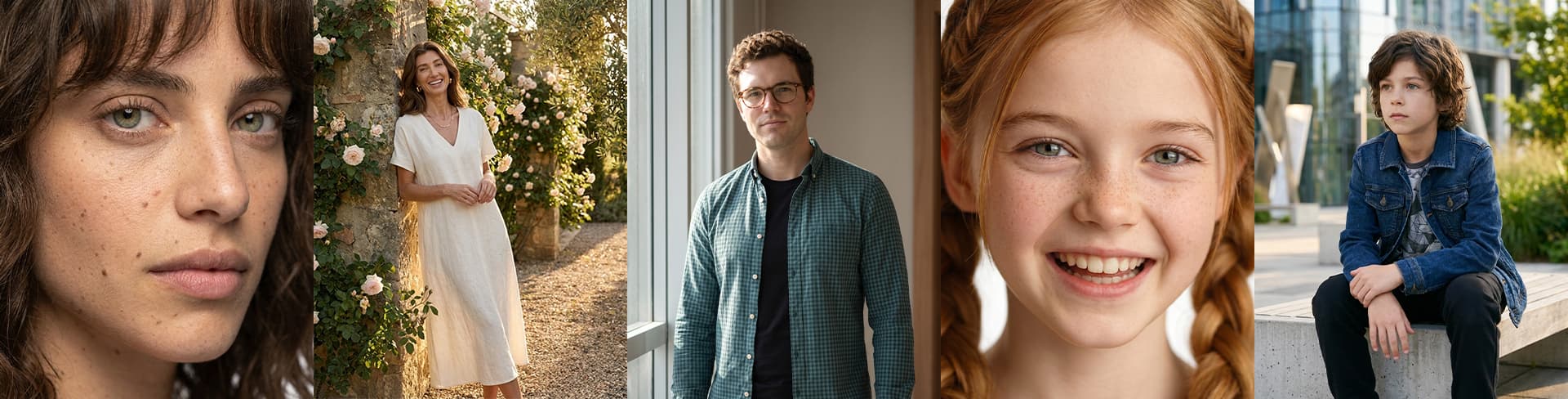
A face that belongs to your company.
One that does not age, does not change agency, does not renegotiate usage rights, can shoot anywhere and speak any language.
We create two distinct things, with different technical and legal implications: synthetic actors owned by the client, and digital replicas of real people, created with their consent.
A testimonial has always been one of the most delicate choices in a campaign. They cost money, contracts must be renewed, they age, and sometimes they end up in the news for reasons that have nothing to do with your product. And when the contract expires, all the recognisability built over the years leaves with them.
An AI actor reverses this logic. The character is designed specifically for your brand, and the image rights remain yours, in perpetuity, with no expiry dates and no renewals. From that moment on, you can have them say and do whatever your communication requires: a commercial today, a product video in six months, a social campaign next year, always with the same face.
Character definition.
Before generating any image, we define who the character is: age, body type, facial features, tone, clothing, and the context in which they will appear. It is a casting process, except that instead of choosing from auditions, we write an identikit. At this stage we also decide how neutral or distinctive the character should be, a choice that depends on the expected duration of the campaign and the markets in which the character will be used.
Generation and selection.
We produce a range of face variations and submit them to the client, exactly as we would with auditions. The selection takes place on static images, before investing in video production.
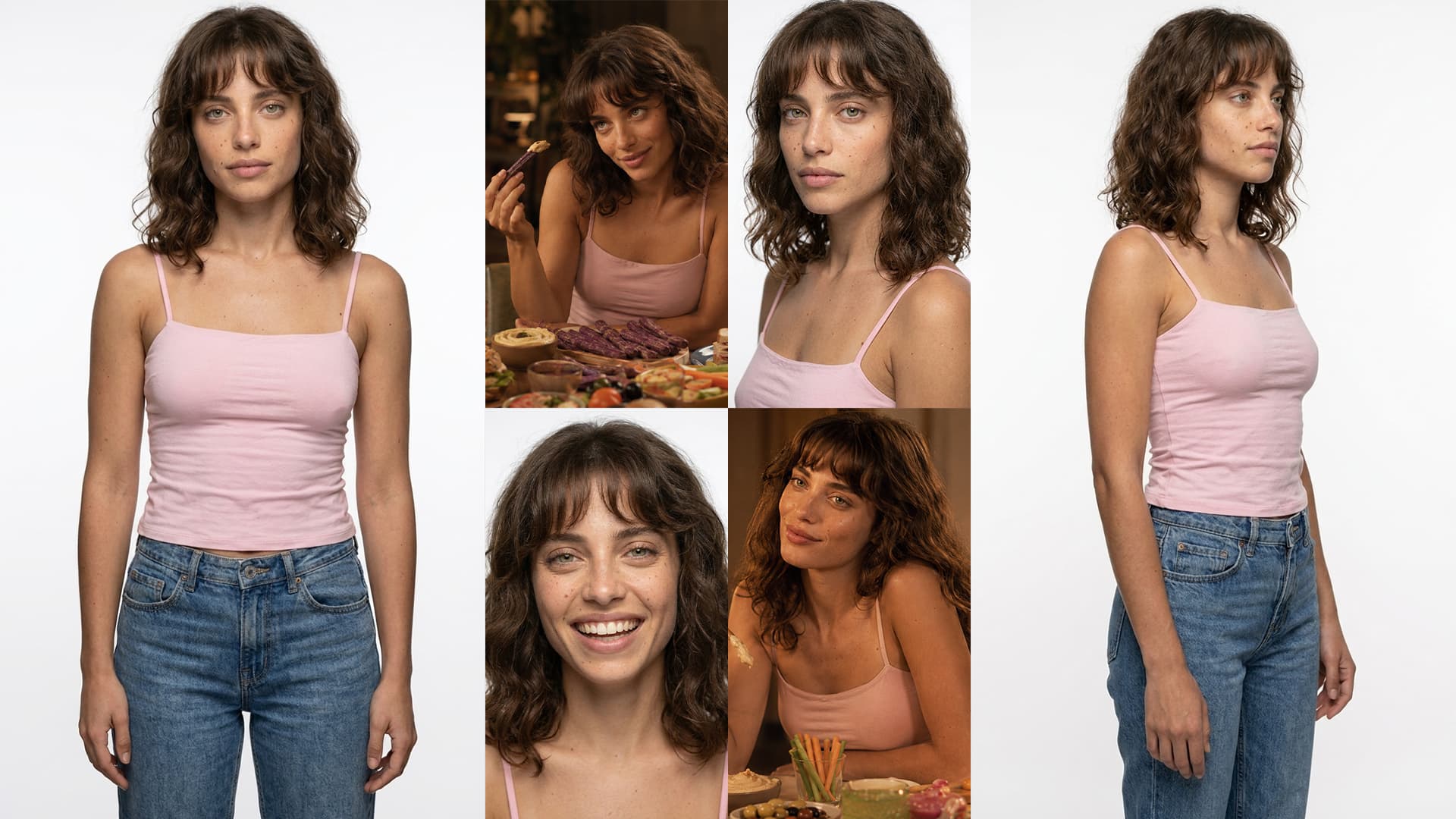
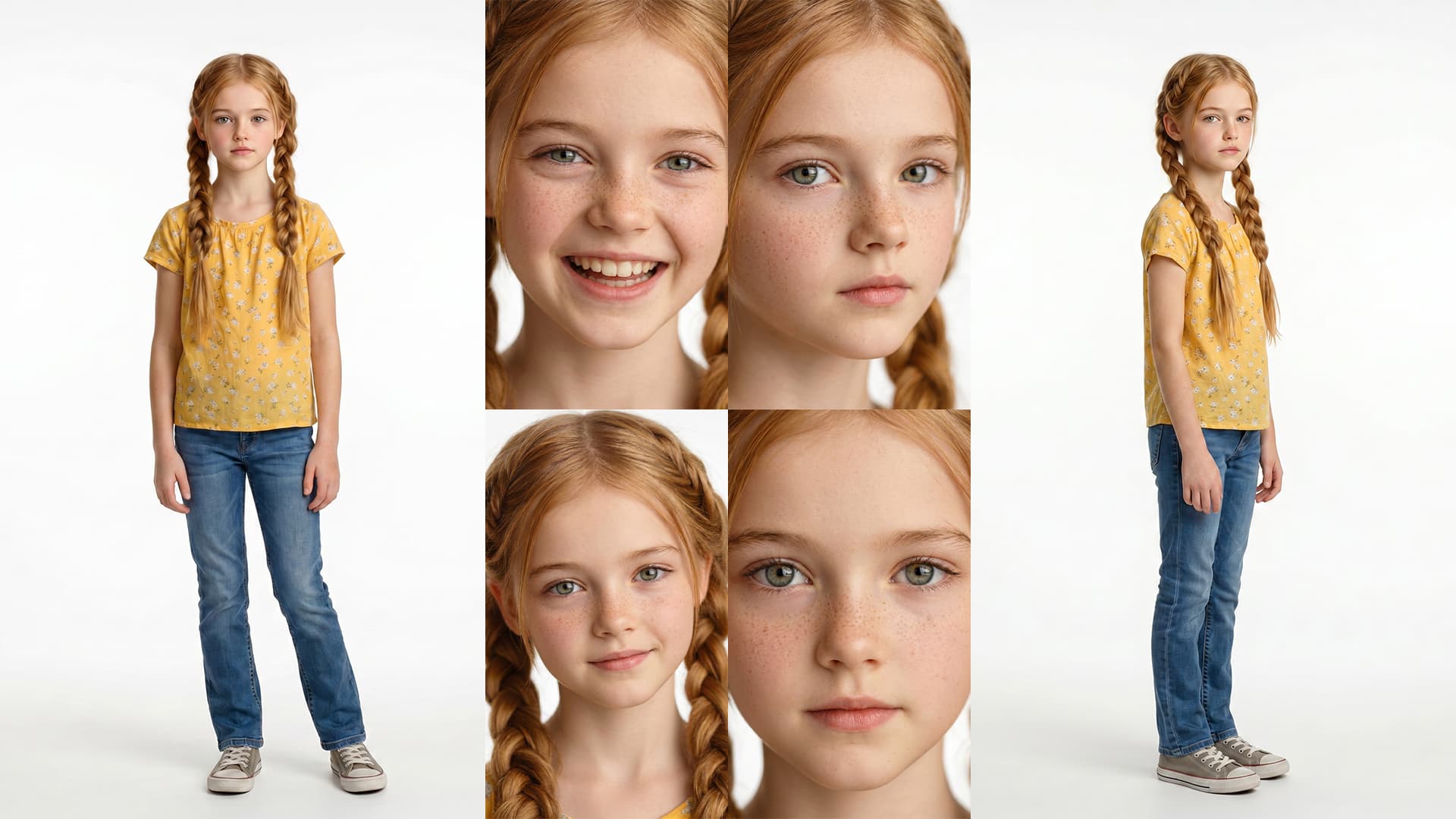
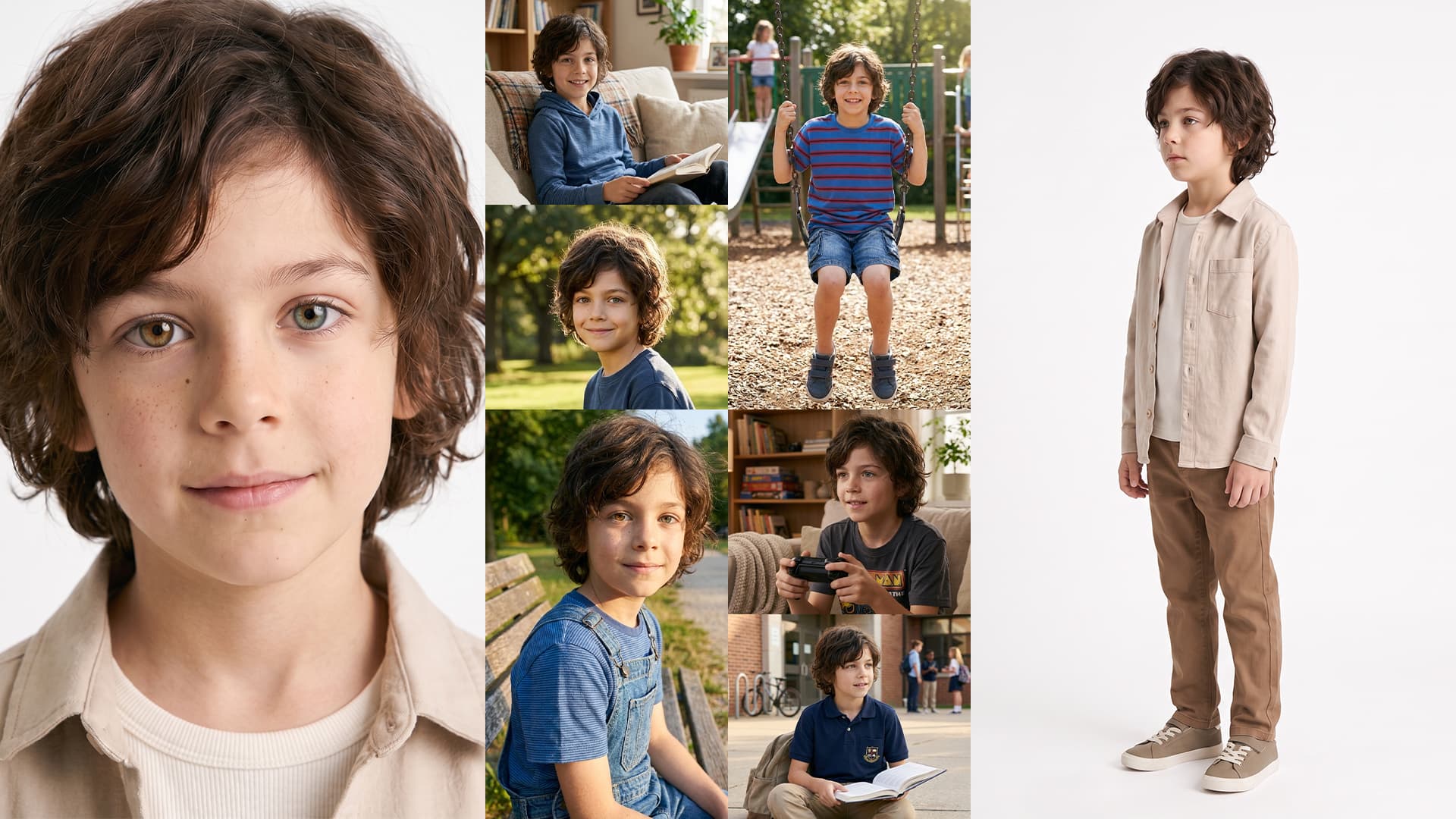
Character sheet creation.
This is the phase that separates a professional project from an occasional generation. The approved face is fixed in a complete reference set: front view, three-quarter view, profile, different shot sizes, different lighting conditions, and a range of expressions. This set is what guarantees the character’s consistency — that the face remains recognisably the same in every scene, in every video, even years later. Without this step, the character “drifts”: it changes imperceptibly from one video to the next, and the viewer perceives it even without being able to explain why.
Voice.
The character needs a voice that is consistent with the face and just as stable over time. A dedicated synthetic voice can be created, or a real voice actor can be engaged, with a contract regulating its use. The two options have different costs and constraints, and the choice depends on how much content is expected over time.
Scene production.
The character is placed in the planned environments, which can be generated entirely or composited onto real footage of your spaces. The second option is almost always the best when the video needs to show your company: the real plant, with your testimonial inside it.
Finalisation.
Upscaling, colour grading, lip synchronisation, audio mix. The same processes as always, on the same hardware we use to treat traditional footage.
Character kit delivery.
We do not just deliver the video: we deliver the asset. The reference set, generation parameters, voice, and rights documentation. This is what makes the character truly yours and reusable, even if one day you choose to work with someone else.
Your actor can speak any language, and not with an overdub: the lip movement is reconstructed according to the phonetics of the target language, so the character genuinely articulates the words being spoken.
It is a visible difference. Traditional dubbing always leaves a gap between what the eye reads on the mouth and what the ear hears: the viewer registers it as a slight sense of distance, even when they cannot say exactly why. With lip reconstruction, that gap disappears, and every market receives a video that feels as if it was shot for them.
In practical terms, this changes the economics of an international campaign. Until recently, ten markets meant ten dubbing sessions, ten voice actors to select, and lip sync that never truly matched. Today it is a variation of the same workflow: languages can be added when needed, even months after the original production, without reshooting anything. The same applies to the digital replica of a real person, who can speak languages they do not know while maintaining the tone of their own voice.
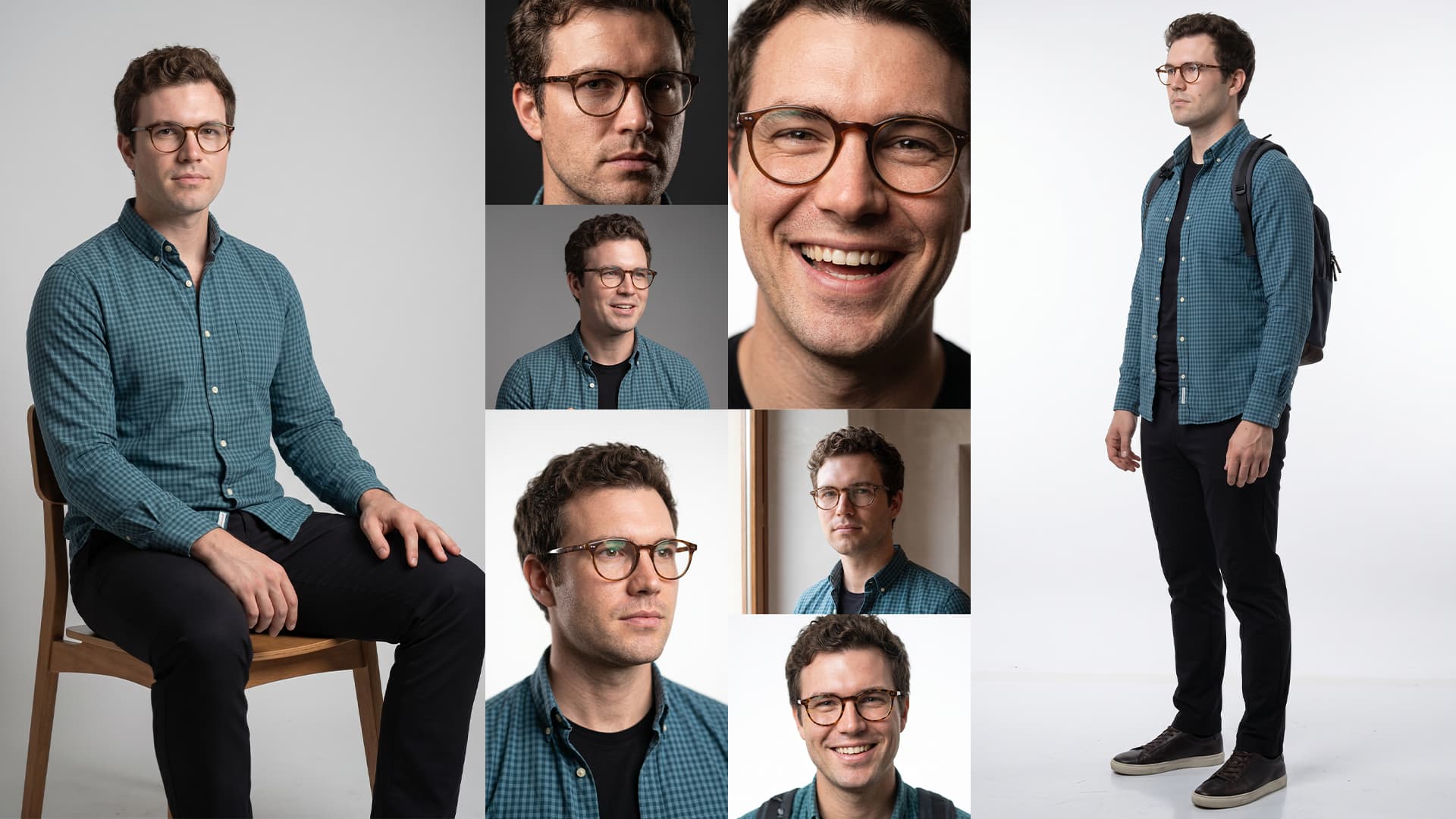
This is currently the request we receive most often. A CEO needs to open a convention but is on the other side of the world. A technical director needs to introduce a product at a trade show on the same day they are in a board meeting. A president needs to send a message to three thousand employees in five languages.
With a sequence of images of the person, a recording of their voice and the text to be read, we create a video in which they truly speak — in their own language or in others, in their office, on a stage, in the middle of a plant or on top of Mount Everest.
Beyond commercials and institutional messages, the applications we are seeing work best are:
Training and workplace safety.
A library of courses with a single consistent presenter, updateable by rewriting the script instead of calling the crew back. For HSE content, the advantage is twofold: risky situations, accidents and incorrect behaviours can be represented without putting anyone in danger and without stopping a plant.
Multilingual versions.
The same testimonial speaking ten languages with their own voice and correct lip sync, with no dubbing and no reshooting.
Updating existing material.
A figure changes, a regulation changes, a product name changes: that sentence is rewritten and the segment is regenerated, without remaking the video.
Recurring internal communication.
Periodic management updates, welcome messages for new hires, department communications. Formats that would have high value but that no one produces because calling the CEO in every month is impossible.
Unreachable environments.
Remote locations, specific weather conditions, operating plants, sterile environments, construction sites. Anything a crew cannot reach or cannot afford to reach.
Long-term continuity.
A character owned by the company does not age, does not move away, and does not become unavailable. A product catalogue updated every season can keep the same face for years without having to call anyone back.
- Images. A series of shots of the person, with uniform lighting, a neutral background, consistent clothing and different angles of the face.
- Voice. A clean audio recording, made in a non-reverberant environment. Enough material is needed to cover the person’s expressive range: neutral reading and natural speech.
- Text. The final script, with intonation notes where needed: where to slow down, what to emphasise, where to pause.
- The person’s written consent. This is not a bureaucratic formality and it is the first document we ask for. We discuss this further below.
From the images, we build the face model, and from the recording, the voice. The text is synthesised using the person’s voice, then the video is generated and synchronised with the speech. The environment is built separately and the subject is integrated into it with coherent lighting and perspective — this is the step that determines whether the result is credible or not, and it is traditional compositing work, not an automated process.
Before delivery, the video is submitted to the person represented for approval. Always, with no exceptions.
This is the part that matters more than the technology, and we recommend reading it before entrusting this kind of work to anyone.
From 2 August 2026, the transparency obligations of Article 50 of the European AI Act apply. Anyone publishing content that represents real people in a way that appears authentic must clearly disclose its artificial nature, and the obligation falls on whoever disseminates the content as part of their professional activity — therefore on the client company, not only on the producer. The sanctions provided for can reach 15 million euros or 3% of worldwide annual turnover.
In Italy, from 10 October 2025, Article 612-quater of the Criminal Code punishes with imprisonment from one to five years anyone who causes unjust harm by disseminating, without the consent of the person concerned, images, videos or voices falsified with artificial intelligence systems and capable of misleading people as to their authenticity.
Our working protocol:
Written and specific consent.
For every digital replica of a real person, we acquire a release form specifying for which content, on which channels, for how long and within which limits the image and voice may be used. Generic consent is not enough.
Final approval by the person represented.
No video is released without the person appearing in it having seen and approved it.
Labelling.
Content that requires it is delivered with an indication of its artificial nature, in the form and position appropriate to the destination channel. We also prepare instructions for your communication department, because the obligation applies at the time of publication.
Traceability.
We keep documentation of consents, source materials and processes. If, three years later, someone raises an issue, the dossier exists.
Revocation management.
People change roles, leave the company, change their mind. The contract defines from the beginning what happens to the model and to the content already produced.
Synthetic actors.
For generated characters, there is no person whose rights need to be protected, but we verify that the face does not bear recognisable similarities to real people and we contractually regulate ownership of the asset in favour of the client.
Generation tools are accessible to many. What is not accessible is everything else: the consistency of the character over time, performance direction, credible integration into real environments, editing, sound, and the management of consents and transparency obligations.
We have been producing videos since 1997 and we handle post-production internally. An AI actor is still an actor: they need to be directed, lit, edited and sound-designed like any other. The difference is that they do not take a plane.

Frequently Asked Questions
A real testimonial brings pre-existing notoriety, which is why they are chosen, but also a fixed-term contract, recurring fees, a schedule and a reputation you do not control. An AI actor has no notoriety of their own: they build it by working for you, and that value remains with the company. They have no contract expiry, are never unavailable and can be used on any channel without renegotiation.
For a synthetic actor, yes: there is no real person holding rights over the image, so the asset is contractually transferred to the client with no time or usage limits. The case of a digital replica of a real person is different: in that case, the rights remain with the person and are granted within the limits defined in the release form.
The character can speak any language, with lip movement reconstructed according to the phonetics of the target language: they genuinely articulate the words they pronounce, it is not an overdub. Languages can also be added months after the original production, without reshooting anything. In the case of a digital replica of a real person, the tone of the voice remains theirs even in languages they do not speak.
It depends on how it is made. The difference is not made by the generation tool, which is accessible to anyone, but by the work around it: the consistency of the face from one scene to another, integration with the light and perspective of the environment, performance direction, editing and sound. A rushed job is immediately recognisable; a well-made project holds up on the channels for which it is intended.
Yes, and this is why we build the character sheet before producing any video. The approved face is fixed in a complete reference set — angles, lights, expressions — which guarantees consistency over the years. Without this step, the character gradually drifts from one video to the next, and viewers perceive it even if they cannot explain why.
No, never. From 10 October 2025, Article 612-quater of the Italian Criminal Code punishes with imprisonment from one to five years anyone who causes unjust harm by disseminating, without consent, images, videos or voices falsified with artificial intelligence and capable of misleading people about their authenticity. For every digital replica, we acquire a written release form specifying content, channels, duration and limits of use, and no video is delivered without the approval of the person represented.
In many cases, yes. From 2 August 2026, Article 50 of the AI Act requires anyone publishing content that represents real people in a way that appears authentic to clearly disclose its artificial nature. The obligation falls on whoever disseminates the content as part of their professional activity, therefore also on the client company. Sanctions can reach 15 million euros or 3% of worldwide annual turnover. We deliver the content with the appropriate labelling for the destination channel and instructions for your communication department.
Yes, and it is often the best choice when the video needs to show the company. The character is integrated into real footage of your spaces through compositing, with coherent lighting and perspective. Alternatively, the environment can be generated entirely, which is the right approach for locations that are unreachable or too expensive to reach.
In addition to the finished video, the character kit: the reference set, generation parameters, voice and rights documentation. This is what makes the character effectively yours and reusable over time, even if one day you choose to work with another supplier.
Yes, and it is one of the main advantages. If a figure, a regulation or a product name changes, the relevant sentence is rewritten and the segment is regenerated, without remaking the video and without calling anyone back. This is particularly useful for training content and product catalogues, which age quickly.
It is one of the most effective applications. It makes it possible to represent risky situations, incorrect behaviours and accident dynamics without exposing anyone and without stopping a plant, while keeping the same presenter across the entire course library, updateable by rewriting the script.
The creation of the character and character sheet is a one-off initial investment, followed by the cost for each individual video. A synthetic actor can cost between €2,000 and €4,000, while the digital replica of a real person, starting from material provided by the client, starts at around €1,000.
Creating a synthetic character takes around 2 weeks. Creating the digital replica of an executive takes around 1 week.


QUOTE? INFORMATION?
If you have a project in mind, the quickest way to understand whether it is feasible is to show it to us.
Tell us what your testimonial needs to say and where: we will tell you what is needed, how long it will take and how much it will cost.